

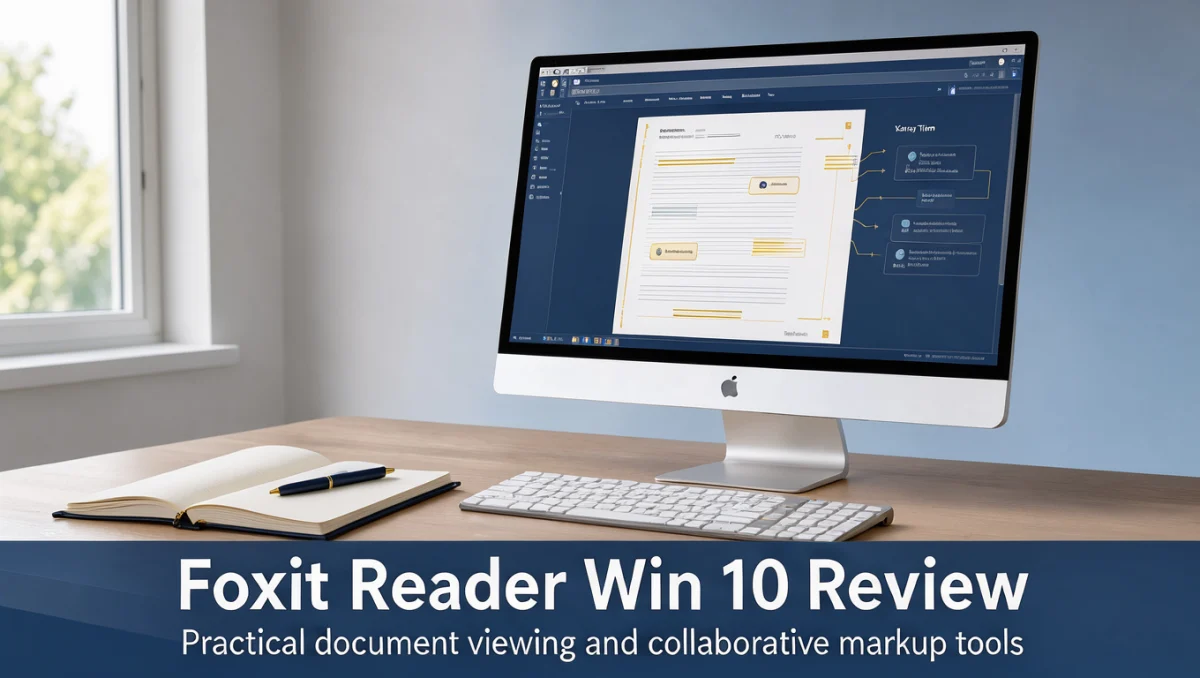
Searching for a reliable way to open, mark up and complete PDFs on a Windows machine? Our hands-on look at foxit reader win 10 explains what the software does well, where it falls short, and how to decide whether it belongs in your office or study routine. Reviews on Review Vault aim to give buyers practical clarity before they commit.
Foxit Reader is a desktop application built to open, view, print and annotate PDF files. It targets people who spend their days reading contracts, research articles, technical manuals and administrative forms, and who need those files to behave predictably across different computers.
Here is the short answer. Foxit Reader earns an overall score of 8.1/10 from our editors. It suits office workers, administrative staff and students who need fast navigation, form completion and markup tools. It is a weaker fit for teams that expect to rebuild page layouts or design vector artwork, since those jobs call for a dedicated authoring suite.
| Evaluation Metric | Review Vault Assessment |
|---|---|
| Review Vault score | 8.1/10 |
| Best for | Office workers, administrative staff and students who read documents, take notes and handle forms |
| Not ideal for | Graphic designers and desktop publishers who need full page reconstruction or vector composition |
| Key strengths | Quick rendering, organized comment management, text markup tools and digital form submission |
| What to check before buying | Licensing structures, user allocation rules and organizational deployment policies on the developer website |
1. How Review Vault Reviewed Foxit Reader Win 10
We assessed the product against seven criteria: features, ease of use, pricing and value, integrations, audience fit, support and competitive position. Plans, prices and limits change frequently, so treat our notes as a starting point and confirm current details on the official website. This article was drafted with the help of AI tools and then reviewed and edited by the Review Vault Editorial Team.
2. What Foxit Reader Is and Who It Serves
Foxit Reader is a document management and reading application from Foxit Software. Its focus is clean file rendering and interactive annotation for people handling electronic paperwork on standard workstations. It addresses everyday friction: reviewing administrative forms, inspecting research papers and passing feedback between distributed colleagues.
The natural audience includes knowledge workers, students, legal clerks and corporate staff who regularly work through contracts, study material and technical documentation. Teams standardizing their collaboration and productivity tools usually look for a reader that opens files without noticeable lag and offers solid markup for review cycles.
Unlike creative design software or full authoring suites, this tool concentrates on consuming, marking up and completing documents. Recognizing that distinction helps teams decide whether standard viewing features are enough or whether they need a heavier creation program.
3. Core Features of Document Readers
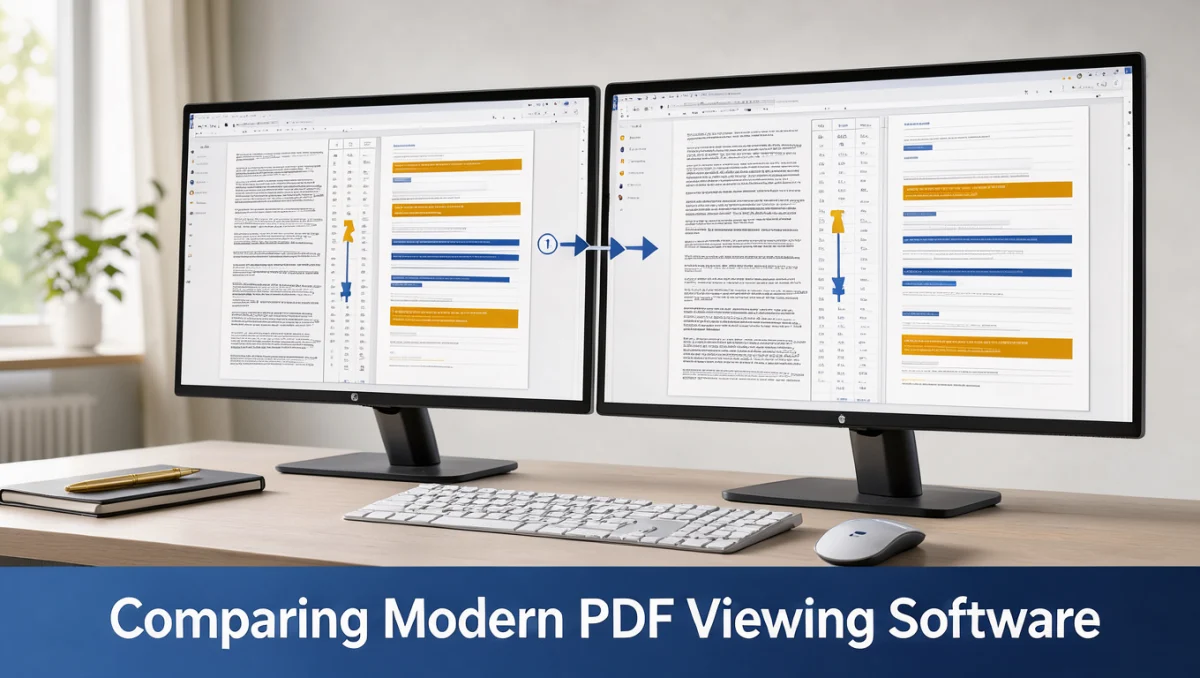
Core capabilities determine how effectively a team reviews records and exchanges feedback. The groups below show how the application handles routine documentation work.
3.1. Document Viewing and Navigation
Navigation tools let you scroll through multi-page files, follow structural bookmarks and jump between sections without delay. Search finds keywords, clause references or figures across long reports. Thumbnail panels and multi-tab layouts make it straightforward to compare a complex document against supporting files.
3.2. Annotation and Collaborative Markup
Reviewers depend on annotation during editing and approval cycles. Typical tools include highlighting, strikethrough, underlining, sticky notes and freehand drawing. Keeping this feedback directly on the source file avoids scattering comments across separate email threads.
3.3. Interactive Form Completion
Forms remain central to administrative, academic and corporate work. Interactive fields accept text, checkbox selections and signature placeholders, so people can finish standard paperwork electronically. Reliable form handling reduces printing costs and speeds up record collection across departments.
3.4. Printing and Export Options
Printing should reproduce electronic files accurately, without distorted margins. Users can select page ranges, adjust scaling and choose monochrome or color output to match archival standards. Clean export options help preserve layout when files move between workstations.
4. Ease of Use and Learning Curve
The interface follows familiar productivity-software conventions, arranging core functions into clear ribbon menus and collapsible sidebars. People moving over from standard office suites will usually find their way around quickly, since document controls, zoom sliders and comment lists sit in predictable places. That familiarity keeps onboarding friction low when a large office rolls the software out to many desks.
The learning curve mostly involves discovering secondary annotation tools and adjusting display preferences. Moving through long technical manuals, switching to continuous scrolling and managing comment layers take little practice. From our editorial perspective, interface consistency is one of the strongest factors in reducing support tickets during company-wide rollouts.
5. Pros and Cons of Foxit Reader Win 10
Weighing strengths against limitations helps buyers set realistic expectations for office deployments.
5.1. Advantages
- Fast rendering that makes it quick to move through long reports and reference guides.
- A broad annotation toolset with highlights, notes and shape markups for clear editorial feedback.
- Dependable interactive form processing that supports digital administrative workflows.
- A familiar ribbon-style layout that cuts training time across departments.
5.2. Limitations and Workarounds
- Restructuring pages is limited compared with dedicated publishing suites, so heavy layout overhauls need separate software.
- Menus can feel dense to casual readers who only scroll pages; simplifying the viewing toolbar helps.
- Commercial terms and deployment rules vary, so administrators should confirm licensing directly on the vendor portal before buying.
6. Foxit Reader vs Similar Tools
Comparing viewers means understanding how each product is positioned. Adobe Acrobat Reader is the long-established standard for reading and printing electronic documents in enterprises, and it is often chosen where legacy compatibility is required.
Sumatra PDF appeals to minimalists who want a very light footprint and instant file opening, but it leaves out deeper collaboration and interactive markup. Nitro PDF targets the full document lifecycle, pairing reading with conversion and publishing tools for corporate environments.
Foxit Reader sits in the middle: responsive reading performance together with strong annotation and form tools, without the overhead of heavy desktop authoring packages.
7. Who Should Use Foxit Reader
Matching capabilities to real workplace demands keeps daily operations smooth.
7.1. Corporate Administrative Teams
Administrators who handle invoices, employee records and compliance forms benefit from reliable form handling and annotation. Standard viewing software lets departments review contracts, add procedural notes and route paperwork without formatting problems.
7.2. Students and Academic Researchers
Scholars working through papers, textbooks and lecture notes will find bookmark navigation and text highlighting useful. Being able to annotate excerpts and export summaries supports thorough revision without complicated software.
7.3. Legal and Professional Service Consultants
Consultants auditing long agreements and policy documents rely on search and margin notes to track key terms. Shared markups help a team reach internal agreement before sending recommendations to clients.
7.4. Teams Who Should Consider Other Options
Creative directors, typographers and print publishers producing magazines or complex marketing material need dedicated vector authoring tools rather than a reader. Users who only open the occasional one-page notice can usually rely on the default operating system viewer.
8. How to Choose the Right Plan
Choosing productivity software means assessing organizational size, functional needs and deployment effort. Use the matrix below when comparing options.
| What to Check | Why It Matters |
|---|---|
| Deployment type and workstation support | Confirms the installer fits central IT rollout policies and your current operating environments. |
| Commercial licensing terms | Ensures compliance across single machines, multi-user offices and corporate networks. |
| Annotation and markup requirements | Verifies staff have the commenting, highlighting and shape tools needed for daily collaboration. |
| Form management capabilities | Determines whether staff can reliably complete, save and submit interactive forms. |
| Support and maintenance | Confirms help resources and technical documentation are available when workstation issues appear. |
9. Frequently Asked Questions
9.1. When is basic document viewing software enough for an office?
Ask whether staff mainly read files, complete forms and add review comments, or whether they regularly rewrite existing text, edit underlying layouts or reorganize pagination. If the daily work centers on reading, signing and reviewing records, a standard reader covers the requirement without extra complexity.
9.2. What should buyers check in organizational licensing?
Review how the vendor defines commercial use, individual installations and network deployment on its official licensing pages. Knowing whether access is tied to machines or to organizational accounts prevents compliance gaps and keeps IT budgets accurate as teams grow.
9.3. Why does form handling matter when choosing a PDF viewer?
Interactive forms are core to modern HR, accounting and compliance processes. Software that captures text entries accurately, supports checkboxes and preserves form data on save prevents lost records and removes the need to print paper copies.
9.4. How should an enterprise plan rollouts across many workstations?
IT managers should consult the official installation guides for silent installer options, configuration switches and centralized update management. Checking administrative deployment features before buying licenses helps ensure a uniform installation without disrupting daily work.
10. Final Verdict
Evaluating document utilities means balancing reading speed, functional range and long-term deployment cost. The table below shows how Foxit Reader performs across our standard dimensions.
| Criterion | Score /10 | Reason |
|---|---|---|
| Features | 8.5 | Practical reading tools, responsive search, text markup and reliable electronic form completion. |
| Ease of Use | 8.5 | A familiar ribbon interface that keeps staff training time short. |
| Pricing and Value | 8.0 | Check commercial terms on the vendor site against your workstation budget. |
| Integrations | 7.5 | Built for standalone document work, so confirm compatibility with internal storage systems. |
| Audience Fit | 8.5 | Lines up well with the everyday needs of administrative staff, students and knowledge workers. |
| Support | 7.5 | Documentation and help channels are available; review response expectations on the official portal. |
| Competitive Position | 8.2 | An established, responsive viewing and annotation option alongside traditional alternatives. |
Overall Score: 8.1/10
For individual professionals, students and corporate departments that need a dependable way to read reports, complete administrative forms and collaborate through markups, Foxit Reader Win 10 is a capable and well-structured choice. Organizations that depend on extensive document creation or vector illustration should look at dedicated page authoring tools for those specialized jobs.
Have questions about choosing productivity software for your team? Contact us at https://reviewvault.net/contact/ or follow Review Vault on LinkedIn at https://www.linkedin.com/company/reviewvault/ for ongoing workplace technology analysis.
See More Collaboration & Productivity